
Upper Palaeolithic
The dating of a butchered bear patella (that had been recovered from Alice & Gwendoline Cave, Co. Clare in 1902) to the Late Upper Palaeolithic revealed the first evidence of human activities in Ireland. Subsequent archaeological excavations in the cave in 2019, and a radiocarbon dating programme of some of the faunal remains from the antiquarian investigation, revealed that reindeer, giant deer and brown bear lived in Ireland during the early centuries of the Younger Dryas ‘cold snap’.
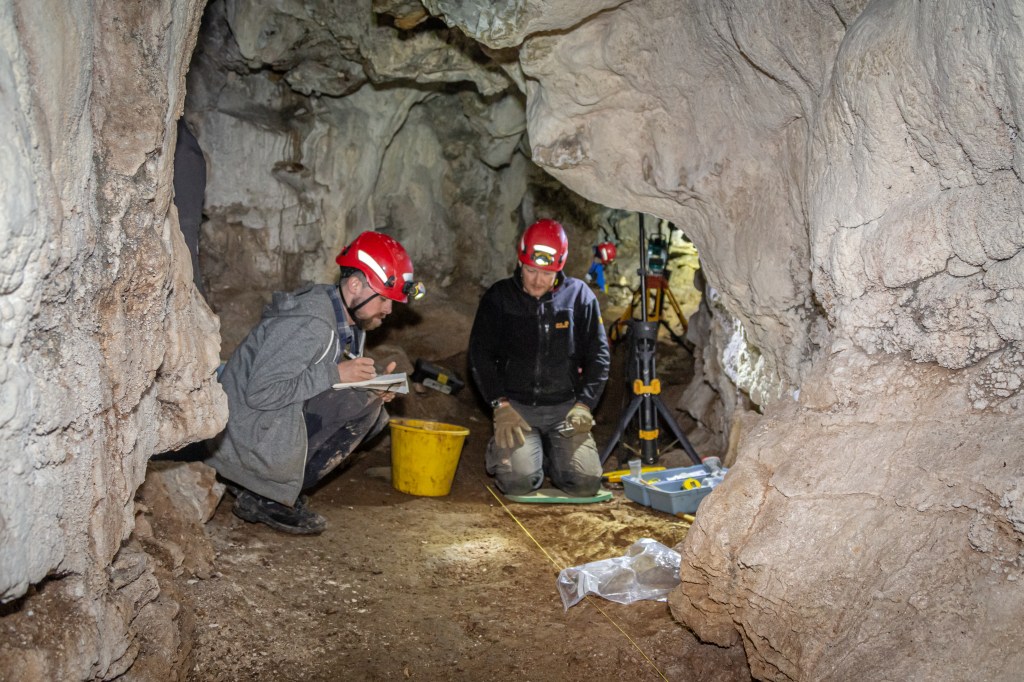
Dowd, M., Stimpson, C., Connolly, R., Bonsall, J., Kahlert, T. and McLaughlin, R. 2024. New insights on the fauna of Ireland’s Younger Dryas and Early Holocene from Alice & Gwendoline Cave. Quaternary Science Reviews 339, 1–14. Read here
Dowd, M., Bonsall, J., Kahlert, T., Connolly, R. and Stimpson, C. 2021. Revisiting Alice and Gwendoline Cave, Co. Clare: new insights on the 1902 excavations. Proceedings of the Royal Irish Academy 121C, 1–53. Read here
Dowd, M. and Carden, R.F. 2016. First evidence of a Late Upper Palaeolithic human presence in Ireland. Quaternary Science Reviews 139, 158–163. Read here
Dowd, M. 2016. A remarkable cave discovery: first evidence for a late Upper Palaeolithic human presence in Ireland. Archaeology Ireland 30(2), 21–25. Read here
 Dr Marion Dowd